• CRE Appraisals: Components, Approaches to Value & Cap Rates

    Types of appraisals by formatWhat to look for within the assumptions and limiting conditions
    Property ownership interests clarified (fee simple, leased fee, etc.)
    Highest and best use of the property
    Approaches to value
    Cost approach and information useful in the underwriting and loan structuring process
    Income approach options of discounted cash flow (DCF) and direct capitalization
  • Security Awareness Training: Best Practices for Keeping Your Employees Engaged

    Cyber Threat’s New NormalPeople, Process, and Technology – which is the weakest link?
    Compliance-based vs. Proactive Security Awareness Training
    Building an Effective Security Awareness Training Program (for all areas of your organization)
    Topical Training Ideas
    Why Accountability Matters Most

  • Deposit Operations: First Quarter Update

    Who is liable to whom on checks? Altered, forged, and fraudulent itemsRule 9
    Regulation CC Inflation Changes
    FDIC Logo, Advertising, and Digital Changes
    Regulation E Unauthorized Transactions, Stop Payments, and Reopening Closed Accounts
    IRA Update: Domestic Abuse, Emergency Savings, Terminal Illness exceptions and repayments
    Nonresident Alien Interest Reporting
    Overdrafts and Junk Fees

  • Converting Accrual Financial Statements Into Cash Flow

    Obtain a good understanding of how to convert an accrual basis financial statement into cash flowKnow how to interpret and explain cash flow analysis to determine the debt repayment capability of the entity
    Know the types of companies prone to utilize cash basis financial statements and why
    Be able to compare various methods to calculate cash flow including the Uniform Cash Analysis (UCA) Method, EBITDA, and Traditional Methodologies, and their advantages/disadvantages
    Know the rules of cash flow required to perform the conversion from accrual to cash
    Be exposed to the Fast Cash Analysis method which can get you to the same results in less time

  • Opening New Accounts – Part 1 (3 Part Series)

    6-Step Account Opening ProcessTIN Compliance
    Personal Account Ownership Overview
    Personal/Consumer Account Difficult Scenarios
    Opening Accounts for Minors – UTMA
    Who Can Access An Account During Lifetime And At Death

  • Frontline Branch Series: Wowing the Client

    The Frontline Branch Series is for retail staff in the branches, or staff wanting to move into the branches. These professionals may be new hires, new to the field, or professionals with years of experience. They are the emerging professionals who want to become qualified to move laterally or forward in the organization.Objective: Addresses the […]

  • Dealing with Appraisals and Valuations: Regulations and Requirements, including Recent Developments – Part 1 (2 Part Series) (5 CRCM Credits)

    Utilizing existing appraisals: Criteria for acceptance
    Appraisal Management Company (AMC) requirements
    Reg. Z valuation rules: When are they applicable?
    Avoiding coercion and undue influence of appraisers
    Reg. Z’s “flipping” rule: Obtaining a second appraisal
    Reg. B rules: Disclosure and copies
    Appraisal bias: What to look for
    The Property Appraisal and Valuation Equity (PAVE) taskforce: Recommendations and future changes

  • AI 101: What You Need to Know about AI and Banking Today

    Types of Artificial Intelligence and their Inherent RisksAI WINS
    Strategic Considerations and Use-Cases of AI in banking
    Risks and Threats of AU (including the strategic risk of NOT using AI)
    Mitigating AI Risk
    Vendor Management of AI
    How to Get Started Using AI

  • Opening New Accounts – Part 2 (3 Part Series)

    Business Account DocumentationResolutions – Purpose and Proper Completion
    Business Taxation Options and Why We Have To Care
    Sole Proprietorships
    General, Limited, Limited Liability, and Limited Liability Limited Partnerships
    Limited Liability Company and Series LLC
    Determining LLC Business and Tax Classification
    Profit and Non-Profit Corporations
    Understanding Sub-Chapter S Corporations (S-Corps)
    Non-Profit Associations, Social Clubs, and Charitable Organizations

  • Opening New Accounts – Part 3 (3 Part Series)

    Defining Trustee, Personal Representative, and Fiduciary Roles and ResponsibilitiesTIN Compliance for Trust, Minor and Fiduciary Accounts
    Proper Account Titling
    Formal vs. Informal Trust Comparison
    Key Questions to Ask When Setting Up Trust Accounts
    Six Pieces of Required Information For all Trust Accounts
    Revocable vs. Irrevocable Trust Accounts
    Payable on Death (POD)
    As Trustee For, In Trust For, Totten Trusts
    Minor Accounts

  • Branch Manager Bootcamp: Business Development

    Objective:This session focuses on the relationship building process to identify how to gain the trust of your client, gain a larger share of wallet, and present solutions that solve your clients’ needs. Key Skill Transfers/Takeaways: Mastering pre-call planning. Learning to call virtually or in-person on the right (most profitable) clients and prospects. Building relationships with […]

  • Frontline Branch Series: Your Advisory Role

    The Frontline Branch Series is for retail staff in the branches, or staff wanting to move into the branches. These professionals may be new hires, new to the field, or professionals with years of experience. They are the emerging professionals who want to become qualified to move laterally or forward in the organization.Objective: Presents opportunities […]

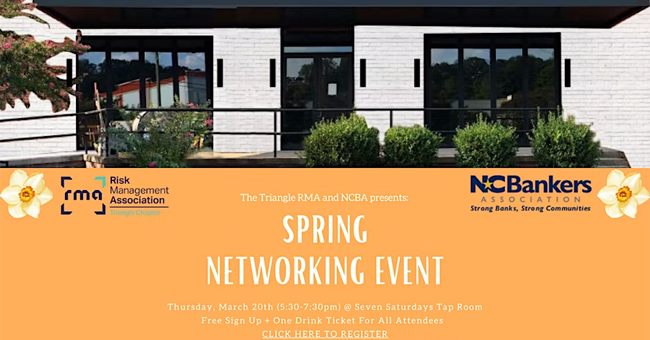
  • Triangle RMA & NCEL Spring Networking Event

    R&D Brewing – Seven Saturdays Taproom 1399 Capital Boulevard, Raleigh, NC, United States

    Come join us at the Triangle RMA and NC Emerging Leaders Spring Networking Event for a great opportunity to connect with professionals in the area!

  • 2025 CBS Benefits Day & HR Workshop

    The CBS Benefits Day & HR Conference is a great opportunity for you to learn more about the employee benefits options available through our association and focus on human resources management with your peers. Don’t miss this annual event!

  • CRE Lending Training Program- Part 1

    Commercial loan officers, private bankers, junior commercial real estate lenders, and other banking professionals who need to understand the basic concepts of commercial real estate lending will benefit from this webinar.

  • Bank Accounting: Beyond the Basics – 5 Part Series – Part 1 (10 CPE Credits)

    The course is designed for those who understand the basis of bank accounting and desire to have a deeper understanding of accounting for more complex activities. In addition, a member of the accounting team that participates in the audit process and works with the bank’s financial statement auditors will improve their understanding of the basic concepts behind the audit assertions and control activities that apply to key areas of the bank’s financial statements, to include the basic concepts of consolidations and preparing a set of consolidated financial statements.

  • Fair Lending Workshop for Community Banks (2.5 CRCM Credits)

    This workshop will be advantageous to anyone with hands-on responsibilities for Fair Lending and/or Community Reinvestment Act compliance as well as those handling loan adverse actions and loan exceptions. This can include loan officers, loan processors responsible for denials and/or second review, compliance officers, and auditors.